
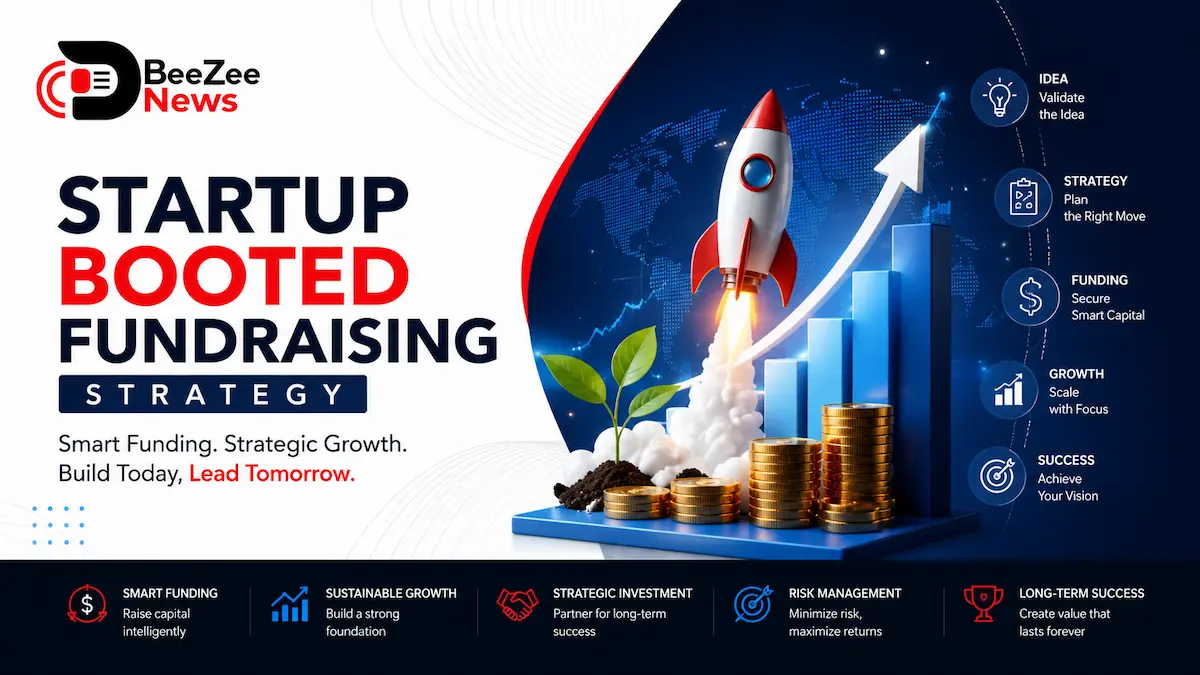

Startup Booted Fundraising Strategy For many founders, the dream of building a successful company often seems to be tied to venture capital. Startup headlines frequently highlight multimillion dollar funding rounds, making external investment appear to be the only path to growth.
In reality, many thriving businesses have followed a different route. A Startup Booted Fundraising Strategy focuses on building revenue, maintaining ownership, and raising capital only when it supports a clear business objective.
This approach has gained attention in recent years as investors have become more selective, and founders have prioritized sustainable growth over rapid expansion at any cost. Rather than chasing funding from day one, bootstrapped companies create value, prove demand, and strengthen their negotiating positions before seeking external capital.
Understanding how this strategy works can help entrepreneurs make smarter financing decisions and build stronger companieGs.
What Is a Startup Booted Fundraising Strategy?
A startup bootstrapped fundraising strategy combines two approaches.
-
Bootstrapping the business initially
-
Raising targeted capital when growth opportunities justify it
Instead of relying on investors from the beginning, founders use personal savings, early revenue, customer payments, and lean operations to fund development and growth.
Once a company achieves traction, fundraising becomes a strategic tool rather than a survival necessity.
This model allows founders to:
-
Retain more equity
-
Maintain decision making authority
-
Validate market demand before fundraising
-
Reduce dependency on investors
-
Build stronger financial discipline
The goal is not to avoid funding. The goal is to raise capital from a position of strength.
Why More Startups Are Choosing This Approach
The startup landscape has changed significantly since then.
During periods of abundant venture capital, many companies focus on rapid growth while accepting substantial losses. However, economic uncertainty and tighter investment markets have shifted attention toward profitability and efficient growth.
Investors increasingly favor startups that demonstrate the following:
-
Strong unit economics
-
Consistent revenue growth
-
Customer retention
-
Operational efficiency
-
Clear paths to profitability
- Startup Booted Fundraising Strategy Like
Bootstrapped companies often excel in these areas because they are forced to focus on the fundamentals from the beginning.
The Key Advantages of a Startup Booted Fundraising Strategy
Greater Ownership Retention
One of the biggest benefits is the preservation of equity. { Startup Booted Fundraising Strategy }
When founders raise large amounts of capital early, they often give away significant ownership stakes before their companies reach meaningful value.
By bootstrapping first, entrepreneurs can increase company valuation before fundraising, reducing dilution, and maintaining a larger share of future success.
Stronger Negotiating Position
Investors prefer businesses that can survive without their funds.
Startups generating revenue and attracting customers have leverage during fundraising discussions. Founders are not forced to accept unfavorable terms simply because they need immediate cash to survive.
Better Financial Discipline
Bootstrapped startups typically learn to operate more efficiently.
Every expense is carefully evaluated, and resources are allocated to activities that directly contribute to growth.
This mindset often creates healthier businesses in the long term.
Customer Centered Growth
When revenue funds operations, customer satisfaction is essential.
Bootstrapped companies tend to prioritize solving real problems because their survival depends on paying customers rather than on continuous fundraising rounds.
How to Build an Effective Startup Booted Fundraising Strategy
Start With Revenue Validation
Before seeking investment, Startup Booted Fundraising Strategy prove that customers are willing to pay for your product or service.
Revenue validation may include the following:
-
Pre-sales
-
Subscription customers
-
Pilot programs
-
Consulting services
-
Productized offerings
Even modest revenue demonstrates market demand and reduces the risk to investors.
Keep Initial Costs Low
Lean operations are the cornerstone of successful bootstrapping.
Founders should focus on the following:
-
Essential hires only
-
Cost effective technology solutions
-
Outsourcing non core tasks
-
Remote or hybrid work models
-
Minimal office expenses
Keeping overhead low extends the runway and improves flexibility.
Focus on Product Market Fit
Many startups pursue funding before confirming that customers genuinely want their solutions.
A better strategy is to achieve a strong product market fit first.
Signs include:
-
Consistent customer growth
-
Positive reviews
-
High retention rates
-
Organic referrals
-
Increasing demand
These indicators strengthen future fundraising prospects.
Use Alternative Funding Sources
Bootstrapped startups are not limited to the use of personal savings.
Alternative funding options include the following:
Revenue Based Financing
Companies receive growth capital in exchange for a percentage of their future revenues.
This model avoids equity dilution and aligns repayments with business performance.
Grants and Innovation Programs
Government agencies, accelerators, and industry organizations often provide non dilutive funding opportunities.
Strategic Partnerships
Business partnerships can provide resources, distribution channels, and development support without traditional investment.
Customer Financing
Pre orders, annual contracts, and enterprise agreements can generate cash flows before significant scaling expenses arise.
Knowing When to Raise External Capital
One of the most important elements of a Startup Booted Fundraising Strategy is the timing.
Fundraising should support proven opportunities rather than compensate for unresolved business challenges.
Good reasons for raising capital include:
-
Expanding into new markets
-
Accelerating customer acquisition
-
Building larger sales teams
-
Scaling infrastructure
-
Launching additional products
Poor reasons include:
-
Covering ongoing losses
-
Fixing weak demand
-
Delaying difficult business decisions
-
Funding unsustainable growth
The strongest fundraising stories show that additional capital will accelerate existing success rather than create it.
Common Mistakes Founders Make
Waiting Too Long to Consider Funding
While bootstrapping has advantages, refusing all outside capital can sometimes limit growth opportunities for startups.
If competitors scale rapidly and market timing is important, strategic fundraising may be necessary.
Growing Without Clear Metrics
Investors want measurable progress to be made.
Founders should track:
-
Monthly recurring revenue (MRR)
-
Customer acquisition cost (CAC)
-
Customer lifetime value (LTV)
-
Churn rate
-
Gross margin
-
Revenue growth rate
Strong metrics increase credibility and valuations.
Overestimating Future Revenue
Bootstrapped companies must remain realistic about their growth projections.
Conservative forecasting reduces financial risks and helps maintain operational stability.
Ignoring Investor Relationships
Even if fundraising is not immediately planned, building relationships with investors is valuable.
Regular networking creates familiarity and trust, making future fundraising conversations more productive and effective.
Real World Characteristics of Successful Startup Booted Fundraising Strategy
Many successful companies share common traits before raising substantial capital.
-
Clear market focus
-
Strong customer relationships
-
Efficient operations
-
Revenue driven decision making
-
Sustainable growth models
-
Disciplined spending habits
These qualities often attract investors because they indicate lower risk and higher potential for long term investment.
Future Trends in Startup Fundraising
Several trends continue to support bootstrapped growth strategies.
Increased Focus on Profitability
Investors are paying closer attention to sustainable business models rather than growth at any cost.
Growth of Alternative Financing
Revenue based financing, crowdfunding, and founder friendly capital options have become increasingly accessible.
AI and Automation Efficiency
New productivity tools allow smaller teams to accomplish more, thereby reducing the need for large early funding rounds.
Founder Control Becoming a Priority
More entrepreneurs are intentionally seeking ways to maintain ownership and strategic control throughout their companies’ growth journeys.
FAQs
1. What is a Startup Booted Fundraising Strategy?
It is a business growth approach in which founders initially fund operations through personal resources and revenue and then raise external capital to accelerate proven growth opportunities.
2. Is bootstrapping better than venture capital?
Neither approach is universally superior. Bootstrapping offers more control and ownership, whereas venture capital can provide resources for rapid scaling. The best choice depends on the business goals and market conditions.
3. When should Startup Booted Fundraising Strategy raise funds?
Startups should consider fundraising after validating demand, generating revenue, and identifying clear opportunities where additional capital can significantly accelerate growth.
4. Can bootstrapped startups attract investors?
Yes. Many investors prefer companies that have demonstrated traction, revenue, and operational discipline before seeking funds.
5. What are the common alternatives to venture capital?
Alternatives include revenue based financing, grants, crowdfunding, strategic partnerships, angel investors, customer financing, and small business loans.
Conclusion
A Startup Booted Fundraising Strategy offers founders a balanced path between complete self funding and immediate investor dependence. By first focusing on revenue generation, operational efficiency, and product market fit, entrepreneurs can build stronger businesses and approach fundraising from a position of confidence.
Startup Booted Fundraising Strategy Rather than viewing capital as the starting point, successful founders treat it as an accelerator of proven success. This mindset not only preserves ownership and flexibility but also creates companies that are better prepared for long term growth in an increasingly competitive startup environment.
visit: BeeZeeNews