
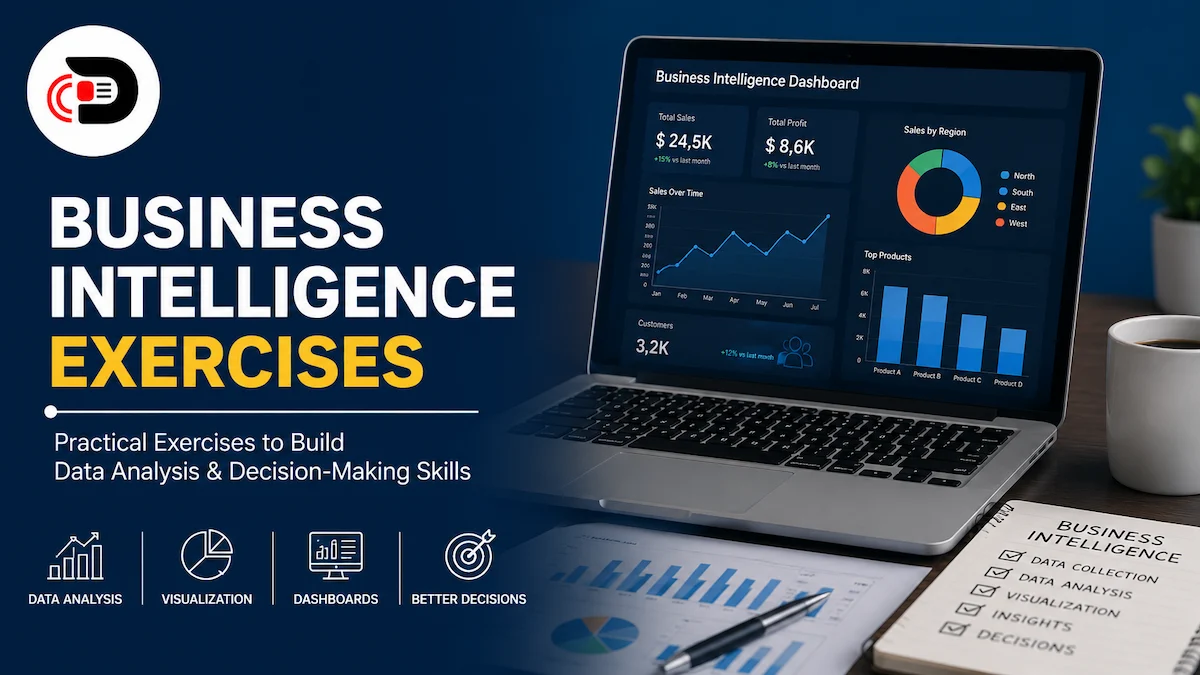

In today’s data driven business environment, collecting information is no longer sufficient. Organizations require professionals who can interpret data, uncover trends, and translate insights into action. Business intelligence exercises play an important role in this regard.
Whether you are a student, analyst, manager, or business owner, practicing business intelligence exercises can sharpen your ability to work with data and make informed decisions. These exercises help develop critical skills, such as data visualization, reporting, dashboard creation, trend analysis, and performance measurement.
As businesses generate more data than ever before, the demand for professionals who can transform raw data into meaningful insights continues to grow. The good news is that many of these skills can be learned and strengthened through practical training.
What Are Business Intelligence Exercises
Business intelligence exercises are structured activities designed to improve a person’s ability to collect, analyze, visualize and interpret business data.
These exercises simulate real world business challenges and encourage participants to use data to answer important questions, such as:
- Why are sales increasing or decreasing?
- Which products generate the highest profits?
- Which customer segments deliver the most value?
- Where are the operational inefficiencies occurring?
- Which marketing campaigns produce the best results?
The goal is not simply to work with spreadsheets or software. The real objective is to learn how to make smarter business decisions using data.
Why Business Intelligence Skills Matter More Than Ever
Modern organizations rely heavily on analytics to remain competitive in the market. From retail and healthcare to finance and manufacturing, data influence nearly every strategic decision.
Recent business trends have increased the importance of business intelligence.
- Growing volumes of business data
- Increased focus on real time reporting
- Expansion of cloud based analytics platforms
- Greater demand for self service dashboards
- Rising need for data driven decision making
Companies actively seek professionals who can identify patterns, monitor performance, and communicate findings effectively.
Like repost: ATT My Results: How to Access, Understand, and Manage Your Test Results Online
Essential Business Intelligence Exercises for Beginners
If you are new to business intelligence, start with foundational exercises that build core analytical skills.
1. Sales Performance Analysis
One of the most common business intelligence exercises involves the analysis of sales data.
A dataset containing the following was used:
- Product names
- Sales revenue
- Units sold
- Regions
- Dates
Try answering questions such as:
- Which products generated the highest revenue?
- Which regions performed the best?
- Are there seasonal sales trends?
- What are the monthly growth rates?
This exercise helps develop analytical thinking and reporting abilities.
2. Creating Basic Dashboards
The dashboard summarizes the key metrics in a visual format.
A dashboard was built that included:
- Total sales
- Profit margin
- Top selling products
- Monthly performance trends
- Regional comparisons
Focus on presenting information clearly, rather than adding unnecessary charts.
3. Customer Segmentation Exercise
Businesses often group customers based on their behavior and value.
Analyze customer data to identify the following:
- High value customers
- Frequent buyers
- One time purchasers
- Customers with declining activity
This exercise introduces the concepts of customer analytics and business strategy.
Intermediate Business Intelligence Exercises
Once you understand the basics, you can move on to more advanced analytical challenges.
Trend Analysis Projects
Trend analysis helps organizations to predict future outcomes based on historical data.
For example:
A retail company may examine three years of sales records to identify the following:
- Seasonal demand fluctuations
- Growth patterns
- Product lifecycle changes
- Emerging market opportunities
Look for recurring patterns, rather than isolated events.
KPI Monitoring Exercise
Key Performance Indicators (KPIs) help measure organizational success.
Create a reporting framework that tracks the following:
- Revenue growth
- Customer retention
- Average order value
- Conversion rates
- Operating costs
The challenge is to determine which metrics truly impact business performance.
Profitability Analysis
Revenue alone does not indicate business success.
Analyze:
- Product costs
- Marketing expenses
- Distribution costs
- Gross profit margins
Many businesses discover that their highest selling products are not necessarily the most profitable.
Advanced Business Intelligence Exercises
Advanced exercises focus on solving complex problems in business.
Executive Dashboard Development
Senior leaders require concise and high level information.
A dashboard was designed that included:
Financial Metrics
- Revenue
- Profit
- Cash flow
Customer Metrics
- Customer acquisition
- Retention rates
- Customer lifetime value
Operational Metrics
- Productivity
- Inventory turnover
- Service performance
The challenge is to balance detail with simplicity.
Business Scenario Analysis
Scenario analysis helps organizations prepare for uncertainties.
Create multiple scenarios, such as the following:
- Revenue increases by 15%
- Operating costs rise by 10%
- Customer demand drops by 20%
- The potential impact on profitability and growth was analyzed.
Competitive Intelligence Exercise
Gather publicly available information about competitors and compare:
- Market position
- Product offerings
- Pricing strategies
- Customer feedback
- Growth trends
This exercise develops strategic thinking and market awareness skills.
Business Intelligence Exercises Using Real Data
Working with realistic datasets creates a valuable learning experience.
Consider analyzing the data from the following:
- E-commerce stores
- Public government datasets
- Financial reports
- Customer surveys
- Marketing campaigns
Try identifying:
- Hidden trends
- Performance bottlenecks
- Revenue opportunities
- Customer behavior patterns
The closer the data resemble real business situations, the more useful the exercise becomes.
Popular Tools for Business Intelligence Practice
Several tools can help learners effectively complete business intelligence exercises.
Spreadsheet Software
Programs such as Microsoft Excel remain valuable for the following:
- Data cleaning
- Basic reporting
- Pivot tables
- Chart creation
- Visualization Platforms
Modern BI platforms allow users to:
- Build dashboards
- Create interactive reports
- Monitor KPIs
- Explore data visually
Database Systems
Learning database fundamentals helps analysts to:
- Retrieve information efficiently
- Combine multiple datasets
- Improve reporting accuracy
Understanding databases is increasingly important for business intelligence (BI) professionals.
Common Mistakes to Avoid
Many beginners focus too heavily on technology rather than on analysis.
Please avoid the following common errors:
- Using too many charts on dashboards
- Ignoring data quality issues
- Reporting metrics without context
- Drawing conclusions from incomplete data
- Focusing on aesthetics over insights
The purpose of business intelligence is to support decisions, not simply to generate reports.
How Organizations Use Business Intelligence Exercises
Many companies incorporate business intelligence exercises into:
- Employee training programs
- Leadership development initiatives
- Analyst onboarding
- Data literacy workshops
- Strategic planning sessions
These activities improve analytical capabilities across departments and encourage a data driven approach.
Building a Long Term Business Intelligence Skillset
Consistent practice is more effective than occasional large scale projects.
A strong learning routine may include the following:
- Weekly dashboard projects
- Monthly business case studies
- KPI analysis exercises
- Industry research assignments
- Data storytelling practice
Over time, these activities strengthen analytical thinking and improve decision making confidence among students.
The Future of Business Intelligence Training
Business intelligence continues to evolve as organizations seek faster and more accurate insights into their operations.
Future BI professionals will need expertise in the following areas:
- Real time analytics
- Data governance
- Cloud reporting systems
- Advanced visualization techniques
- Data storytelling
While tools may change, the ability to interpret information and communicate findings clearly remains a valuable skill.
FAQs
1. What are the business intelligence exercises?
Business intelligence exercises are practical activities that help individuals learn to collect, analyze, visualize, and interpret business data to support better decision making.
2. Who can benefit from the business intelligence exercises?
Students, analysts, managers, business owners, and professionals involved in reporting or decision making can benefit from developing business intelligence skills.
3. What skills do business intelligence exercises improve?
These exercises improve data analysis, dashboard creation, reporting, KPI tracking, problem solving, critical thinking, and data visualization skills.
4. Which tools are commonly used for business intelligence practices?
Popular tools include spreadsheet software, database systems, reporting platforms, and business intelligence visualization tools used for analytics and dashboard development.
5. How often should I practice business intelligence exercises?
Regular practice of this technique is recommended. Weekly exercises and real world business case studies help build stronger analytical skills.
Conclusion
Business intelligence exercises are one of the most effective ways to develop data driven decision making skills. From simple sales analysis projects to advanced executive dashboards and scenario planning, these exercises help transform raw data into meaningful business insights. As organizations continue to rely on analytics for growth and competitiveness, professionals who can interpret information, identify trends, and communicate findings clearly will be in high demand. Consistent practice, combined with a focus on real world business problems, is the key to mastering business intelligence and delivering lasting value to organizations.