

Introduction Company classification sectors and verticals
Understanding company classification sectors and verticals is essential in the current business environment. Whether you are an investor evaluating opportunities, a business owner researching competitors, or a professional exploring industry trends, company classifications provide a structured way to understand how organizations operate.
Companies are often grouped into sectors, industries, and verticals based on their primary activities, products, services, and target markets. These classifications help investors compare similar businesses, enable market researchers to analyze trends, and allow organizations to identify potential opportunities in their industries.
As global markets become increasingly interconnected, accurate company classification is becoming increasingly important. Businesses are expanding into new markets, adopting digital technologies, and creating innovative products that sometimes blur the traditional industry boundaries.
What Are Company classification sectors and verticals?
The company sector is a broad category that groups businesses engaged in similar economic activities.
Sectors represent the highest level of business classification and provide a general overview of a company’s activities. Financial analysts, stock exchanges, and research firms commonly use sector classifications to organize companies into groups.
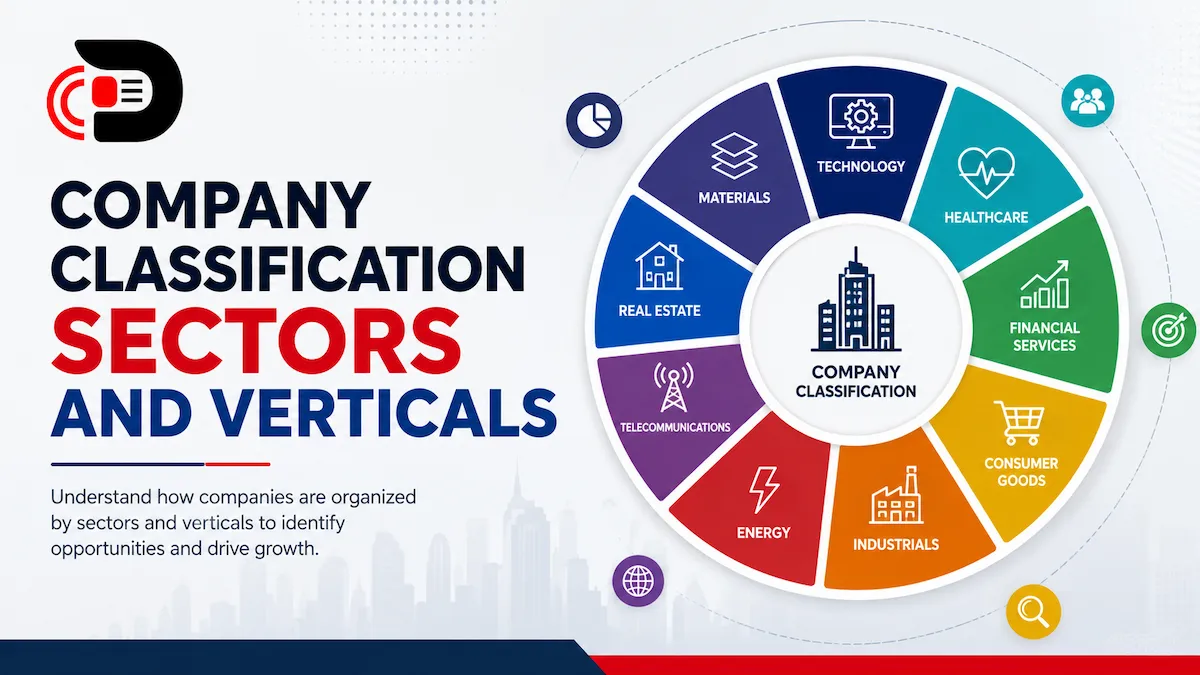
Some widely recognized sectors include
- Technology
- Healthcare
- Financial Services
- Energy
- Consumer Goods
- Consumer Services
- Industrials
- Telecommunications
- Utilities
- Real Estate
- Materials
For example:
-
A software company typically belongs to the technology sector.
-
Commercial banks fall under Financial Services.
-
A pharmaceutical manufacturer is classified as a healthcare provider.
These classifications facilitate the comparison of businesses operating in similar economic environments.
Understanding Business Verticals
While sectors are broad, verticals are more specific.
A vertical refers to a particular market segment or specialized area within an industry. Companies often focus on serving a specific vertical rather than the entire sector.
For example, within the technology sector, common verticals include:
Healthcare Technology
Companies that develop software and digital solutions for hospitals, clinics, and healthcare providers.
Examples include:
- Electronic health record systems
- Medical scheduling platforms
- Telemedicine providers
Financial Technology (FinTech)
Businesses that offer technology-driven financial services.
Examples include:
- Digital banking platforms
- Payment processors
- Online lending solutions
Educational Technology (EdTech)
Organizations focus on learning and educational solutions.
Examples include:
- Online learning platforms
- Virtual classrooms
- Corporate training software
By targeting specific verticals, companies can develop expertise and tailored solutions for their customers.
Difference Between Sectors and Verticals
Although these terms are sometimes used interchangeably, they serve different purposes.
|
Sector |
Vertical |
|---|---|
|
Broad business category |
Specific market segment |
|
Groups similar industries |
Focuses on niche markets |
|
Used for economic analysis |
Used for targeted business strategies |
|
Covers large portions of the economy |
Covers specialized customer needs |
For example:
- Technology = Sector
- Healthcare Software = Vertical
- Financial Services = Sector
- Digital Payments = Vertical
A company may belong to one sector while serving multiple verticals.
Why Company Classification Matters
Business classifications are more than just organizational labels. They influence decision-making in multiple areas.
Investment Analysis
Investors use sector classifications to:
- Compare similar companies
- Assess industry performance
- Diversify portfolios
- Identify emerging trends
For example, investors interested in renewable energy may focus on companies within the energy sector while examining specific clean energy verticals.
Market Research
Researchers rely on classifications to:
-
Measure industry growth
-
Track consumer behavior
-
Analyze competitive landscapes
-
Forecast future opportunities
Business Development
Companies use sector and vertical analyses to:
- Identify target customers
- Expand into new markets
- Develop specialized products
- Create effective marketing strategies
Common Company Classification Frameworks
Several globally recognized systems help to classify companies consistently.
Global Industry Classification Standard (GICS)
The GICS is one of the most widely used classification systems in financial markets.
It organizes companies into the following categories:
- Sectors
- Industry Groups
- Industries
- Sub-Industries
Investors frequently use GICS classifications to analyze public companies.
Industry Classification Benchmark (ICB)
The ICB is another popular framework used by stock exchanges and financial institutions worldwide.
The system categorizes businesses into multiple levels, allowing for detailed industry analysis.
North American Industry Classification System (NAICS)
NAICS is widely used in North America for:
-
Government reporting
-
Economic analysis
-
Business statistics
-
Industry research
Many organizations use NAICS codes to identify businesses that operate in specific markets.
Modern Trends in Company Classification
Business models are evolving rapidly, creating new challenges for the classification systems.
Rise of Digital-First Companies
Many companies operate in multiple industries simultaneously.
For example:
-
E-commerce platforms may also offer financial services.
-
Technology firms may provide healthcare solutions to address these challenges.
-
Retail companies can also develop software products.
As a result, classification frameworks continue to adapt to reflect modern business realities.
Growth of Cross-Industry Verticals
Emerging verticals increasingly span multiple sectors, including
-
Artificial Intelligence Solutions
-
Cybersecurity Services
-
Sustainable Energy Technology
-
Smart Manufacturing
-
Digital Health
These areas often combine expertise from several traditional industries.
ESG and Sustainability Categories
Environmental, Social, and Governance (ESG) considerations influence how investors evaluate companies.
The following organizations were involved in this study:
- Renewable energy
- Carbon reduction
- Sustainable manufacturing
- Green technology
are receiving increasing attention from investment communities.
Examples of Company Classifications
Understanding real-world examples helps clarify the concept.
Technology Sector
Possible Verticals:
-
Cloud Computing
-
Cybersecurity
-
Software-as-a-Service (SaaS)
-
Artificial Intelligence
-
Data Analytics
Healthcare Sector
Possible Verticals:
- Pharmaceuticals
- Biotechnology
- Medical Devices
- Telehealth
- Healthcare Software
Financial Services Sector
Possible Verticals:
- Banking
- Insurance
- Wealth Management
- FinTech
- Payment Solutions
Consumer Goods Sector
Possible Verticals:
- Food and Beverage
- Personal Care
- Household Products
- Luxury Goods
- Sustainable Consumer Products
Challenges in Company Classification
Modern organizations often operate across multiple industries.
Some common challenges include:
Diversified Business Models
Large corporations may generate revenue from several sectors.
For instance, a company might operate:
- Cloud infrastructure services
- Advertising platforms
- Consumer electronics products
Determining the primary classification can be complex.
Rapid Innovation
New technologies frequently create categories that did not exist a few years ago.
Examples include:
- Blockchain platforms
- Generative technology services
- Autonomous vehicle systems
Classification systems must continually evolve to accommodate these innovations.
Global Expansion
International businesses often serve different markets across regions, creating additional classification complexities.
How Businesses Can Use Sector and Vertical Data
Organizations can gain strategic advantages by understanding industry classifications.
Improve Market Positioning
Knowing your sector and vertical helps communicate value clearly to customers and investors.
Identify Competitors
Companies can benchmark performance against businesses operating within the same classification.
Discover Growth Opportunities
Vertical analysis can reveal underserved markets and emerging customer needs.
Strengthen Marketing Efforts
Targeted campaigns become more effective when businesses understand the specific verticals they serve.
FAQs Company classification sectors and verticals
1. What is the difference between a company sector and a vertical?
A sector is a broad economic category such as Technology or Healthcare, while a vertical is a specialized market segment within that sector, such as Cybersecurity or Telemedicine.
2. Why are company classifications important?
They help investors, analysts, researchers, and businesses compare organizations, analyze trends, and make informed decisions.
3. Can a company belong to multiple verticals?
Yes. Many companies serve multiple verticals while remaining part of a single primary sector.
4. What are the most common company classification systems?
Popular systems include GICS (Global Industry Classification Standard), ICB (Industry Classification Benchmark), and NAICS (North American Industry Classification System).
5. How do investors use sector classifications?
Investors use them to evaluate industry performance, compare competitors, manage portfolio diversification, and identify growth opportunities.
Conclusion Company classification sectors and verticals
Company classification sectors and verticals provide a structured framework for understanding how businesses operate within the economy. Sectors offer a broad view of an organization’s primary activities, while verticals reveal the specific markets and customer segments it serves.
As industries continue evolving through digital transformation, sustainability initiatives, and emerging technologies, company classifications remain a valuable tool for investors, researchers, and business leaders. Understanding these classifications can improve strategic planning, competitive analysis, investment decisions, and market positioning, making them an essential part of modern business intelligence.