
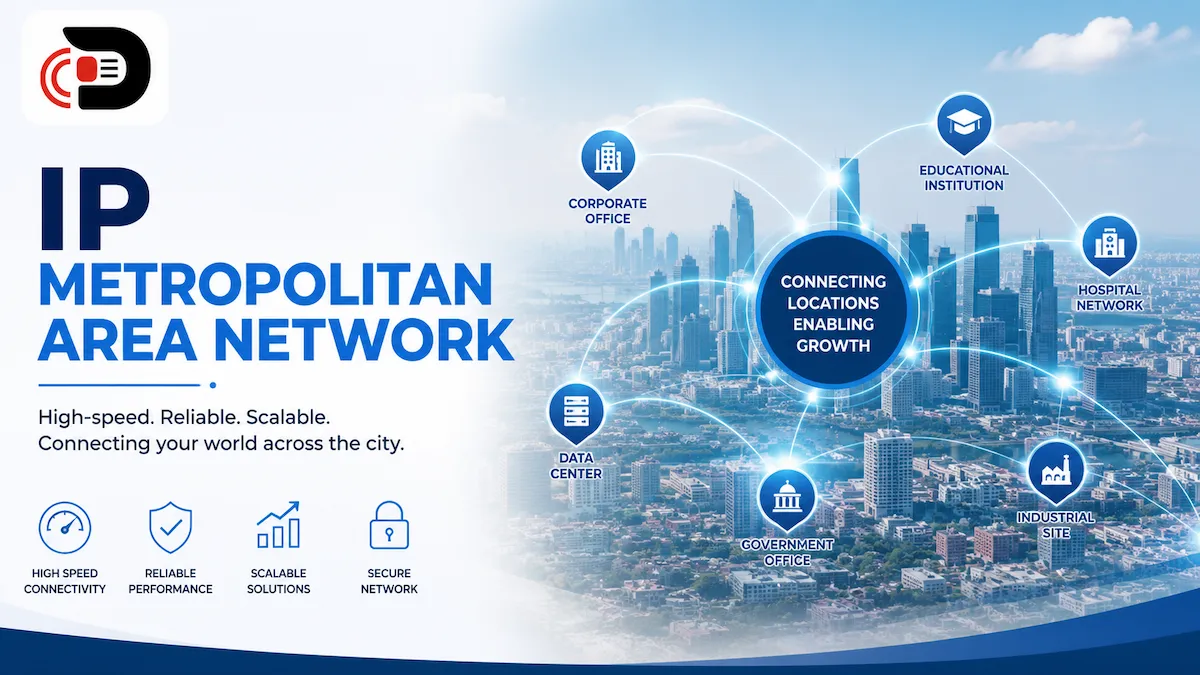

Today, businesses rarely operate from a single location. A company may have a headquarters downtown, a warehouse on the outskirts of the city, and several branch offices spread across different neighborhoods. An IP Metropolitan Area Network (IP MAN) is used to connect all these locations efficiently.
An IP Metropolitan Area Network is designed to connect multiple networks across a city or metropolitan region using Internet Protocol (IP) technology. It offers far greater coverage than a Local Area Network (LAN) while avoiding the complexity and expense often associated with large-scale Wide Area Networks (WANs).
As organizations continue to adopt cloud services, remote collaboration tools, and data-intensive applications, the role of IP MAN infrastructure has become increasingly significant.
What Is an IP Metropolitan Area Network?
An IP Metropolitan Area Network (IP MAN) is a high-speed network that links multiple locations within a city or urban area. This allows offices, campuses, data centers, and public facilities to communicate as if they are part of a single, unified network.
Consider it a digital highway running through a city. Instead of vehicles, it carries data quickly and securely between connected locations.
For example, a university with campuses in different parts of a city can use an IP MAN to provide students and staff with seamless access to shared resources, online learning platforms and administrative systems.
How an IP MAN Works
At its core, an IP Metropolitan Area Network relies on high-capacity communication links, typically fiber-optic infrastructure, to transport data between connected sites.
Data travel through routers and switches that are strategically placed throughout the network. These devices determine the most efficient route for information, ensuring smooth communication, even during heavy traffic periods.
Key Components of an IP MAN
Core Network Infrastructure
The backbone of the network consists of powerful routers and switches that can handle large amounts of traffic.
Fiber-Optic Connectivity
Most modern metropolitan networks are built on fiber-optic cables because they offer the following advantages:
- High bandwidth capacity
- Low latency
- Excellent reliability
- Future scalability
Edge Devices
Routers located at branch offices, campuses, or data centers connect local networks to the metropolitan backbone network.
Network Management Systems
These systems help administrators monitor performance, identify issues, and maintain the stability of the network.
Why Organizations Use IP Metropolitan Area Networks
Many organizations reach a point where standard Internet connections are no longer sufficient for their growing communication needs.
An IP MAN offers several advantages:
Improved Communication Across Locations
Employees working from different offices can access shared applications, files, and services without noticeable delay.
For instance, a financial services company with five offices across a city can use an IP MAN to centralize customer databases while ensuring that every branch has fast access.
Better Support for Cloud Applications
Modern businesses rely heavily on cloud-based software solutions. Slow or unreliable connectivity can affect productivity.
An IP MAN provides the bandwidth necessary to support
- Cloud storage platforms
- Video conferencing
- Enterprise software
- Remote collaboration tools
- Data backups
Scalability for Future Growth
As organizations expand, new locations can be added without rebuilding the entire network architecture.
Reduced Operational Costs
Maintaining separate, dedicated connections between every office can be expensive. A metropolitan network provides a more efficient approach by centralizing the connectivity.
Common Technologies Behind IP MAN Networks
Several networking technologies are commonly used to build metropolitan networks.
Metro Ethernet
Metro Ethernet remains one of the most popular options because it extends the familiar Ethernet technology across larger geographic areas.
Benefits include:
- Easy deployment
- Flexible bandwidth options
- Cost-effective operation
- Compatibility with existing systems
MPLS (Multiprotocol Label Switching)
MPLS helps to optimize traffic flow and prioritize important applications.
For example, a hospital may prioritize telemedicine consultations and patient data over less-critical traffic.
Software-Defined Networking (SDN)
Many modern network providers are incorporating SDN to improve automation and network management.
This allows administrators to adjust network policies more quickly and respond to changing business requirements accordingly.
Best Idea post Premiekalkulator V75
Real-World Applications of IP Metropolitan Area Networks
The practical value of an IP MAN becomes clear when examining its use in different industries.
Enterprise Businesses
Large organizations often operate in multiple offices within the same metropolitan area.
An IP MAN helps them:
- Share resources efficiently
- Centralize data management
- communication between teams
- Enhance business continuity
Healthcare Networks
Healthcare providers rely on fast and secure data transmissions.
Hospitals can use metropolitan networks to transfer
- Medical imaging files
- Electronic health records
- Laboratory results
- Telehealth communications
Without reliable connectivity, delays can directly affect patient care.
Educational Institutions
Universities frequently operate multiple campuses, research facilities, and administrative buildings that require energy.
An IP MAN allows these locations to function as a connected ecosystem, thereby improving collaboration among students, faculty, and researchers.
Government Agencies
Municipal governments often connect various departments through metropolitan networks.
Examples include:
- Emergency services
- Public transportation systems
- Utility management
- Administrative offices
Smart City Projects
As cities become more connected, the metropolitan networking infrastructure plays a critical role.
Smart city initiatives often depend on IP MANs to support
- Traffic monitoring systems
- Public Wi-Fi networks
- Smart street lighting
- Environmental sensors
- Security surveillance systems
IP MAN vs LAN vs WAN
Understanding the differences between network types helps organizations choose the appropriate solution.
|
Feature |
LAN |
IP MAN |
WAN |
|---|---|---|---|
|
Coverage Area |
Building or Campus |
City or Metropolitan Area |
Regional or Global |
|
Typical Speed |
Very High |
High |
Varies |
|
Deployment Cost |
Lower |
Moderate |
Higher |
|
Complexity |
Low |
Medium |
High |
|
Common Users |
Homes and Offices |
Enterprises and Institutions |
Multinational Organizations |
An IP MAN is often the ideal choice when connectivity is required across multiple sites within the same city.
Security Considerations
A larger network footprint creates additional security challenges for the network.
Organizations typically implement multiple layers of protection, including
- Firewalls
- Virtual Private Networks (VPNs)
- Data encryption
- Network segmentation
- Access control systems
- Continuous monitoring
Strong security practices help protect sensitive information and ensure compliance with industry regulations.
Emerging Trends Shaping IP Metropolitan Area Networks
Technology continues to evolve, and metropolitan networks are evolving accordingly.
Integration with 5G Infrastructure
Telecommunications providers increasingly rely on metropolitan fiber networks to support the expansion of 5G deployments.
Growth of Edge Computing
Businesses are moving processing power closer to users and devices to reduce the latency and improve the application performance.
Increased Demand for Smart Infrastructure
Cities worldwide are investing heavily in connected technologies that depend on reliable metropolitan networks.
Higher Capacity Requirements
The growth of cloud computing, streaming services, and connected devices is driving the demand for faster and more resilient networks.
Choosing an IP MAN Solution
Before implementing an IP Metropolitan Area Network, organizations should evaluate the following:
- Current bandwidth requirements
- Future growth plans
- Security needs
- Reliability expectations
- Available infrastructure
- Budget considerations
A well-designed network should support both current operations and future expansion without requiring significant redesign.
FAQs
1. What does IP MAN stand for?
IP MAN stands for IP Metropolitan Area Network, which connects multiple locations across a city or metropolitan region using Internet Protocol technology.
2. How does an IP MAN differ from a LAN?
A LAN typically covers a single building or campus, whereas an IP MAN connects multiple sites across an entire city.
3. Which industries commonly use IP MAN networks?
Healthcare, education, government, telecommunications, finance, and large enterprises frequently rely on IP Metropolitan Area Networks.
4. Is fiber-optic infrastructure necessary for an IP MAN?
Although alternative technologies exist, fiber optics are widely preferred because they offer higher speed, lower latency, and better reliability.
5. Can an IP MAN support cloud-based applications
Yes. IP MAN networks are well suited for cloud computing, video conferencing, remote collaboration, SaaS platforms, and data backup services.
Conclusion
An IP Metropolitan Area Network serves as a vital link between local and wide-area networks, providing reliable connectivity across an entire city. Whether connecting business offices, university campuses, hospitals, government departments, or smart city infrastructure, an IP MAN delivers the speed, scalability, and flexibility required by modern organizations.
As digital transformation continues and urban areas become increasingly connected, the importance of metropolitan networks will only grow. For organizations seeking efficient, secure, and future-ready communication across multiple locations, an IP Metropolitan Area Network remains one of the most practical and effective solutions.
repost end Enterprise Compensation Management