
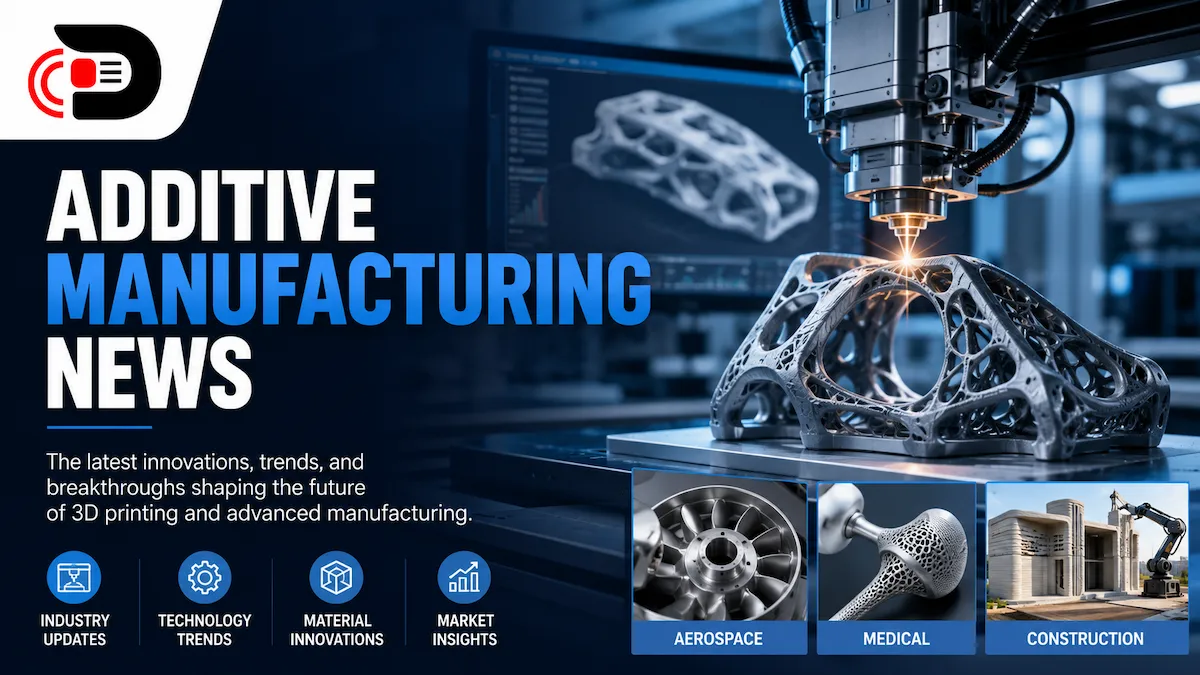

Manufacturing is undergoing one of its most significant transformations in decades, and additive manufacturing continues to be at the center of that change. Once viewed primarily as a prototyping tool, additive manufacturing (commonly known as industrial 3D printing) has evolved into a powerful production technology used across the aerospace, healthcare, automotive, construction, and consumer industries.
Recent additive manufacturing news has highlighted rapid advancements in printing speed, materials science, automation, and large-scale production capabilities. As businesses search for more flexible and resilient supply chains, additive manufacturing has become a practical solution rather than an experimental technology.
This article explores the latest developments and emerging trends in AI and their implications for manufacturers, engineers, and businesses worldwide.
What Is Additive Manufacturing?
Additive manufacturing is a production process that creates objects layer-by-layer from digital designs. Unlike traditional subtractive manufacturing, which removes material through cutting or machining, additive manufacturing builds components precisely where material is needed.
This technology supports various materials, including:
- Metals
- Polymers
- Resins
- Ceramics
- Composite materials
- Bio-compatible materials
Its ability to produce complex geometries with minimal waste has made it increasingly attractive in various industries.
Why Additive Manufacturing News Matters Today
The manufacturing landscape is rapidly changing. Companies face challenges such as labor shortages, supply chain disruptions, rising material costs, and an increasing demand for customized products.
Additive manufacturing addresses many of these issues by offering the following:
- Faster product development cycles
- Reduced material waste
- On-demand production
- Localized manufacturing
- Greater design freedom
- Lower inventory requirements
As adoption grows, industry news often signals broader shifts in product design, production, and delivery.
Major Trends Dominating Additive Manufacturing News
Industrial-Scale Production Is Expanding
One of the most notable developments is the transition from prototype to full-scale manufacturing.
Several manufacturers now use additive manufacturing to produce end-use parts in significant volumes. Improvements in machine reliability and production speed have enabled companies to integrate 3D printing into regular manufacturing workflows.
Industries such as aerospace and medical devices have been among the earliest adopters, but automotive and consumer goods manufacturers are increasingly adopting them.
Metal 3D Printing Continues to Advance
Metal additive manufacturing remains one of the fastest-growing segments in the industry.
New systems can produce stronger and more precise metal components while reducing the production time. Industries that require lightweight yet durable parts, such as aviation and defense, are investing heavily in metal-printing technologies.
Recent developments include the following:
- Improved laser powder bed fusion systems
- Faster directed energy deposition processes
- Enhanced quality monitoring systems
- New metal alloy formulations
These advancements are helping manufacturers move beyond prototypes to high-value production.
Automation Is Improving Efficiency
Automation has become a major focus in the field of additive manufacturing.
Modern production environments increasingly combine the following:
- Robotic handling systems
- Automated material loading
- Real-time monitoring
- Digital quality control
- Smart production scheduling
This integration reduces human intervention and improves consistency and throughput.
For manufacturers seeking scalable solutions, automation is becoming as important as the printers themselves.
New Materials Are Expanding Possibilities
High-Performance Polymers
Material innovation remains one of the biggest growth drivers in the industry.
Engineers now have access to advanced polymers that can withstand extreme temperatures, chemicals, and mechanical stress. These materials open new opportunities in sectors such as aerospace, energy, and healthcare.
Examples include:
- PEEK
- PEKK
- ULTEM
- Carbon-fiber reinforced composites
These materials offer performance characteristics that rival those of traditional manufacturing options.
Sustainable and Recycled Materials
Sustainability has become a major theme in manufacturing sectors.
Recent additive manufacturing news frequently highlights efforts to develop the following:
- Recycled polymer filaments
- Bio-based materials
- Reduced-waste production methods
- Circular manufacturing systems
As environmental regulations become stricter, sustainable materials are expected to play an increasingly important role.
Healthcare Continues to Benefit from Additive Manufacturing
Healthcare remains one of the most exciting applications of additive manufacturing.
Medical professionals use 3D printing to create the following:
- Patient-specific implants
- Surgical guides
- Dental restorations
- Prosthetic devices
- Anatomical models for surgical planning
Customized medical solutions improve patient outcomes while reducing the production timeline.
Researchers are also exploring advanced bioprinting techniques that may support future tissue engineering and regenerative medicine developments.
Aerospace and Defense Drive Innovation
The aerospace sector continues to advance additive manufacturing technology.
Aircraft manufacturers increasingly use 3D-printed parts because they can reduce the weight while maintaining structural integrity.
Benefits include:
- Improved fuel efficiency
- Fewer assembly components
- Reduced production costs
- Faster replacement part manufacturing
Defense organizations are also investigating mobile additive manufacturing systems that can produce parts closer to operational environments and reduce logistical challenges.
Construction 3D Printing Gains Momentum
Large-scale additive manufacturing has gained significant attention in the construction industry.
Construction companies are experimenting with 3D-printed:
- Residential homes
- Commercial buildings
- Infrastructure components
- Concrete structures
This technology has the potential to reduce labor requirements, lower material waste, and accelerate project timelines.
Although adoption remains in its early stages, ongoing projects demonstrate growing confidence in additive construction methods.
Supply Chain Resilience Becomes a Key Advantage
One lesson learned from recent global disruptions is the importance of supply chain flexibility and resilience.
Additive manufacturing enables companies to:
- Produce parts closer to customers
- Reduce dependence on overseas suppliers
- Manufacture spare parts on demand
- Minimize warehouse inventory
This distributed manufacturing model can improve responsiveness and reduce transportation costs of the products.
As organizations rethink their supply chain strategies, additive manufacturing is becoming an increasingly valuable tool.
Challenges Facing the Industry
Despite the impressive progress, several obstacles remain.
Certification and Standards
Many industries require rigorous testing and certification before adopting new manufacturing processes.
Ensuring consistent quality across different machines and facilities is an ongoing challenge.
Material Costs
Certain advanced materials and metal powders remain expensive, limiting their adoption for some applications.
However, increasing competition and larger production volumes may lower costs over time.
Workforce Development
As technology advances, manufacturers need professionals with expertise in the following areas:
- Design for additive manufacturing
- Material science
- Digital engineering
- Quality assurance
Workforce training continues to be a priority in the industry.
What the Future Looks Like
The future of additive manufacturing appears increasingly promising.
Industry experts expect continued progress in the following areas:
- Multi-material printing
- Faster production systems
- Artificial intelligence-assisted quality control
- Digital manufacturing networks
- Sustainable production methods
- Mass customization
As hardware, software, and materials continue to improve, additive manufacturing is likely to become a standard component of modern production strategies rather than a specialized alternative.
FAQs
1. What is additive manufacturing?
Additive manufacturing is a production process that creates objects layer-by-layer from digital designs. It is commonly known as industrial 3D printing and is used in many industries.
2. Which industries use additive manufacturing the most?
Aerospace, healthcare, automotive, defense, consumer products, and construction are among the leading industries that have adopted additive manufacturing technologies.
3. What are the advantages of additive manufacturing?
The key benefits of AM include reduced material waste, faster prototyping, greater design flexibility, localized production, and the ability to manufacture complex parts efficiently.
4. Is additive manufacturing suitable for mass production?
Yes. Advances in equipment, automation, and materials have made additive manufacturing increasingly viable for certain types of high-volume production.
5. What materials can be used for additive manufacturing?
Common materials include plastics, resins, metals, ceramics, composites, and specialized biocompatible materials for medical applications.
Conclusion
The latest additive manufacturing news reflects an industry that is rapidly moving from innovation to widespread implementation. Advances in metal printing, automation, material science, and large-scale production have expanded the role of this technology across multiple sectors. From healthcare and aerospace to construction and supply chain management, additive manufacturing is helps organizations improve efficiency, reduce waste, and create products that were previously difficult or impossible to manufacture. As technology continues to mature, its influence on the future of manufacturing is expected to increase.
Visit: bee zee news